
Schemes to Support Students from Low or Lower-Middle-Income Countries
MUBAS' International Students framework explicitly provides scholarship opportunities for international students, including opportunities supported through partners such as the German Academic Exchange Service (DAAD). The University also provides international students with support relating to admission, study-permit facilitation, accommodation, affordable medical schemes, cultural orientation, social integration and access to student services. This demonstrates that MUBAS's support for students from other countries extends beyond admission to measures that facilitate successful participation in university life.
DAAD scholarship
A key scheme is the DAAD In-Country/In-Region Scholarship Programme, which provides scholarship opportunities for Master's-level study at MUBAS. The programme is specifically designed for graduates from Sub-Saharan Africa who wish to pursue postgraduate studies in their home country or elsewhere in the region. Its stated objectives include strengthening higher education systems in Sub-Saharan Africa, developing qualified professionals and academic leaders, strengthening regional networking, and reinforcing the participation of women and underprivileged groups.
The DAAD scholarship at MUBAS provides an additional example of this regional support mechanism. The call invited eligible applicants to pursue an MSc programme at MUBAS and specifically encouraged female and underprivileged applicants to apply. The scholarship is therefore not simply an academic exchange opportunity; it provides an avenue through which students from disadvantaged backgrounds in the region can access postgraduate education at MUBAS with external scholarship support.
In 2025, this scholarship opportunity, seven (7) MUBAS students benefited from scholarship support, helping them access higher education and advance their academic and professional development. By providing financial assistance to eligible students, these opportunities reduce financial barriers to education and support the admission and progression of students who may struggle to meet the costs of higher education. Further benefits include:
- Full tuition fee coverage
- Monthly living stipend
- Health insurance
- Travel allowance
- Financial support for academic research
- Study-related expense assistance
- Access to university academic and research facilities
Africa Sustainability Infrastructure Mobility Scholarship
Africa Sustainability Infrastructure Mobility (ASIM) is the consortium of four (4) Universities (Ardhi University, Covenant University, University of Johannesburg, Malawi University of Business and Applied Sciences – MUBAS) and an EU Technical partner (Leeds Beckett University) under the European Union Commission Grant on Intra-Africa Academic Mobility Scheme Call Reference No. EACEA/07/2020. Opportunities exist in the third round for suitable qualified, and highly motivated applicants from Africa to apply to study at any of the following institutions: UNIVERSITY OF JOHANNESBURG (South Africa), MUBAS (Malawi), ARDHI UNIVERSITY (Tanzania) and COVENANT UNIVERSITY (Nigeria).
The Africa Sustainability Infrastructure Mobility (ASIM) Scholarship,is an Intra-Africa Academic Mobility initiative involving MUBAS. The programme provides opportunities for qualified African applicants to undertake Master's and PhD studies at participating universities, including MUBAS. MUBAS has advertised both full scholarship opportunities and credit-seeking mobility opportunities under the programme, thereby expanding access to advanced education across African countries.
Student Exchange Programs
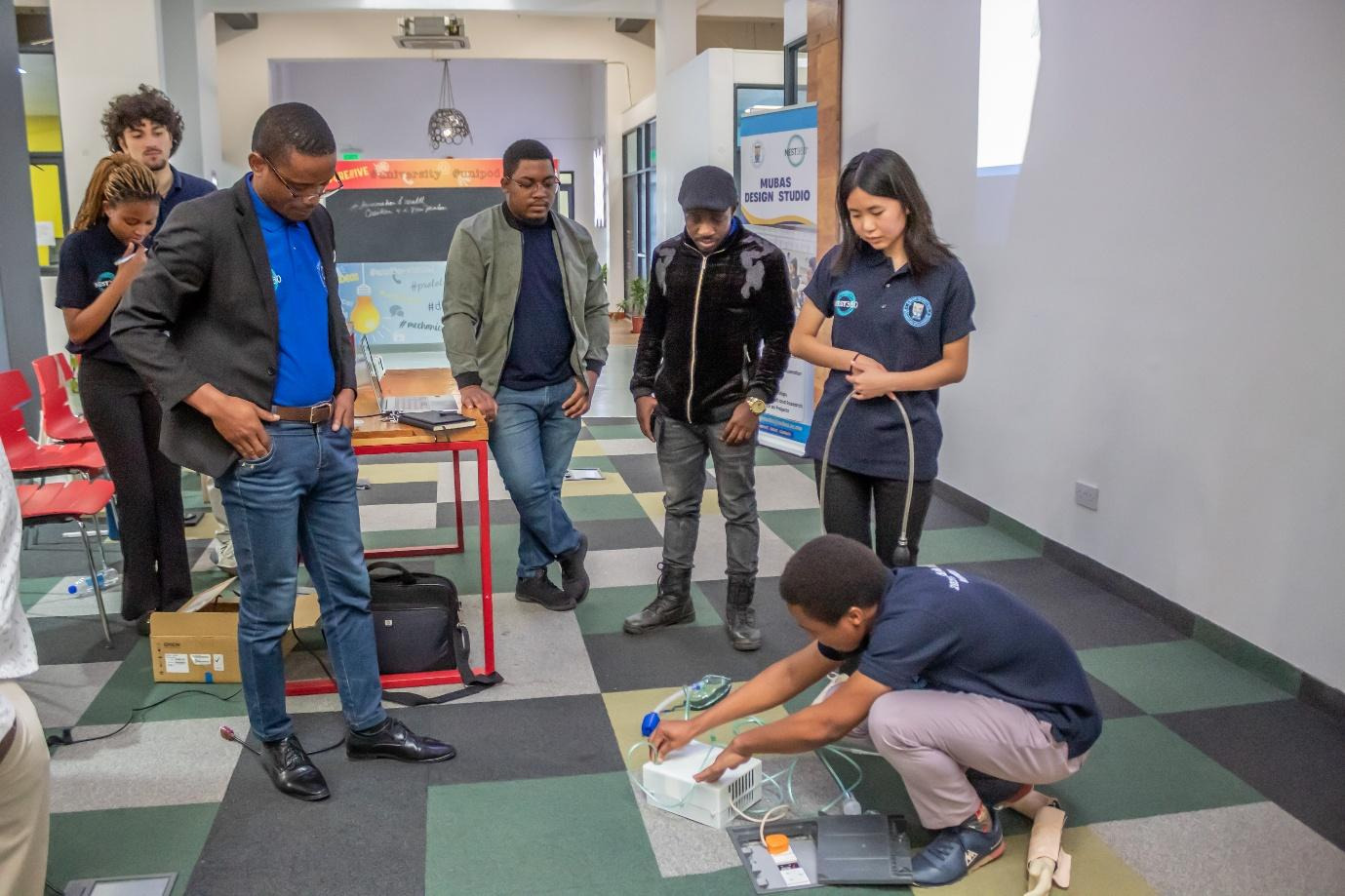
Students from Rice 360 and MUBAS showcase their innovation
In collaboration with Rice University NEST 360, MUBAS contributes to the development of technical skills, knowledge sharing, mentorship and practical learning opportunities through partnerships in health technology innovation and capacity building, valued at USD 5,000. NEST 360 recognises MUBAS as one of its partners in Malawi, with a technical laboratory and design studio that support the development of locally relevant healthcare technologies.
In 2025, two students from MUBAS and two students from Rice University participated in the student exchange programme, benefiting from collaborative learning, practical experience and exposure to new knowledge and skills. Through this partnership, students have gained opportunities to strengthen their academic and professional development, broaden their learning experiences and build the confidence and competence needed to complete their studies successfully.
To further support their success, students participating in the programme receive additional monitoring, mentorship and guidance through the MUBAS Design Studio. This support helps them remain focused on their studies, address academic challenges and reduce the risk of dropping out before completing their qualifications.
Through this collaboration, MUBAS demonstrates its commitment to providing students with opportunities that strengthen their academic progression and improve their chances of completing their studies. By supporting student development and helping learners remain on track towards graduation, the partnership contributes to reducing educational inequalities and expanding opportunities for future employment and improved livelihoods.
Financial assistance
At institutional level, MUBAS maintains a broader financial-assistance system through the Directorate of Student Affairs. The University assists underprivileged students in accessing loans, scholarships and other funding opportunities with the stated objective of ensuring that financial challenges do not prevent students from graduating. MUBAS currently reports 7,018 financial-aid beneficiaries out of 9,954 students, demonstrating the significant scale of financial assistance available across the institution.
The University's financial-support framework also includes the Kwera Fund, which provides financial support to students enrolled at local universities while combining financial assistance with employability and entrepreneurship development. In addition, MUBAS facilitates access to the Higher Education Students' Loans and Grants Board (HESLGB), whose mandate includes providing financial support to needy and deserving students and promoting equitable access to higher education for underprivileged students in Malawi.
MUBAS further reduces financial barriers through government tuition subsidies, institutional bursaries and scholarships, flexible tuition payment arrangements and external scholarships. The University states that eligible normal-entry undergraduate students benefit from a government tuition subsidy covering over 90% of costs, while MUBAS allocates more than MK100 million annually through its Endowment Fund to support students based on financial need, including tuition, accommodation and stationery. In 2025, MUBAS reported that 70.51% of its student population benefited from financial-support programmes.
These mechanisms are complemented by partnerships with external organisations to sustain support for students experiencing financial hardship. For example, FDH Bank contributed MK150 million to the MUBAS Endowment Fund to assist needy students with tuition, upkeep and e-learning resources, including digital devices. The contribution was explicitly linked to concerns that financial constraints were preventing some students from completing their studies. Similarly, Magnus Holdings supports 14 MUBAS students through a scholarship covering tuition and cost-of-living expenses, alongside mentorship and coaching designed to strengthen beneficiaries' professional and entrepreneurial development.